Pret A Manger
Making a quick meal ready before the customer arrives
Drawn only from public sources accessed in October 2026; company announcements and a former chief executive’s recollections are identified as such. Not reviewed or endorsed by Pret A Manger.
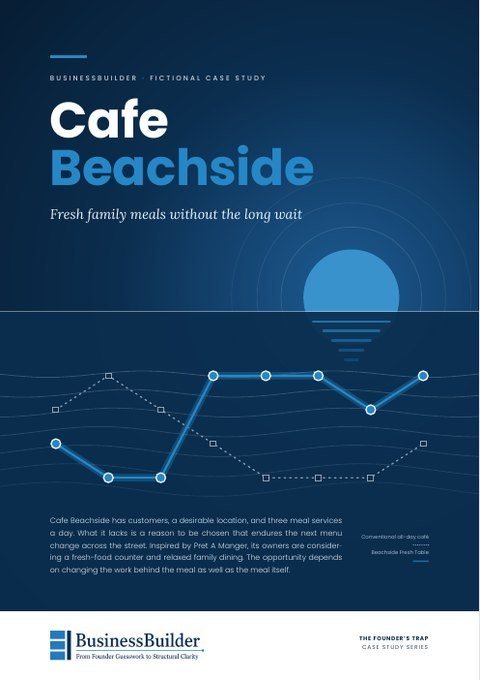
Pret A Manger opened in London in 1986, founded by Julian Metcalfe and Sinclair Beecham, and moved early from a conventional deli counter to packaged grab-and-go food. Customers with a short meal break gained immediacy; the shop took on the work of preparing food before it knew what would sell. This researched case is the companion to the fictional Cafe Beachside, which borrows Pret’s operating model for a seaside café.
Public sources show the offer, its format changes and reported company totals. They do not show site contribution, waste rates or subscription economics, so the case treats those as questions, not conclusions.
What the case found
- Removing the wait moves the risk. Preparing ahead lets customers pick up food immediately, but the shop commits ingredients and labour before demand is known. Neither maximum availability nor minimum waste is automatically the best economic outcome.
- Food information is part of the product. A 2018 coroner’s report into the death of Natasha Ednan-Laperouse identified inadequate allergen labelling. In 2019 Pret announced full ingredient labelling across its UK shops. The lesson: labels, recipes and supplier specifications must be connected inside the operation.
- A strong routine can be a shared dependency. Pret reported 2020 revenue of £299 million, down 58% from £708 million in 2019, when office travel stopped. Many shops shared one underlying exposure; the response moved towards regional shops, digital channels, subscriptions and retail.
- Scale is not proof of every shop’s economics. Pret reported 2025 system sales of £1.2 billion, an operating profit of £37 million and more than 750 shops across 21 countries. System sales, company revenue and different profit measures are not like-for-like, and franchise sales are not Pret’s own revenue.
How can a business remove waiting and uncertainty for customers without transferring too much uncertainty into its own kitchen, workforce and cash flow?
Inside the full case study
Key ideas in this case
- Value innovation — removing service steps to make buying easier while avoiding some order-by-order work; it holds only if replenishment is disciplined.
- Shared dependency — many outlets can still share one exposure, such as office commuting; counting shops does not measure resilience.
- Measures are not interchangeable — system sales, company revenue, adjusted EBITDA and operating profit answer different questions.